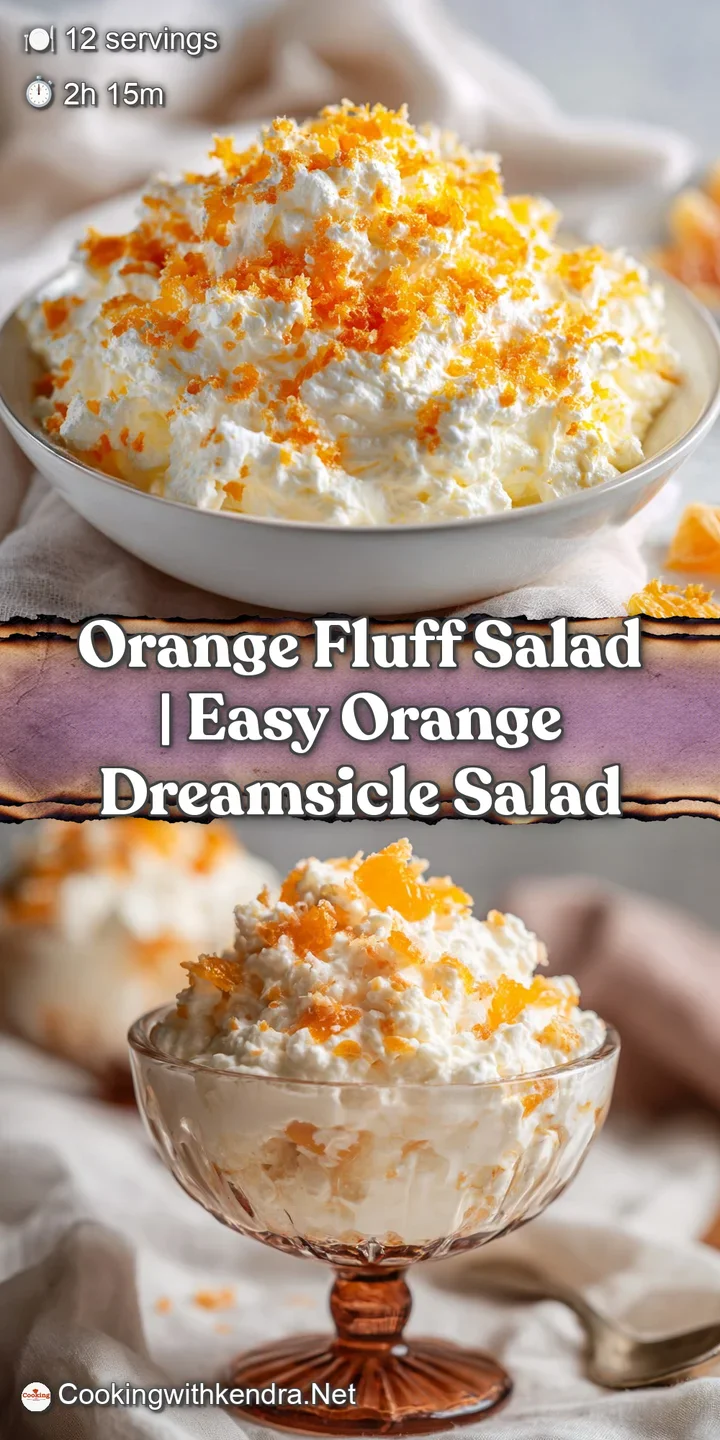
Orange Fluff Salad: Velvety and Bright
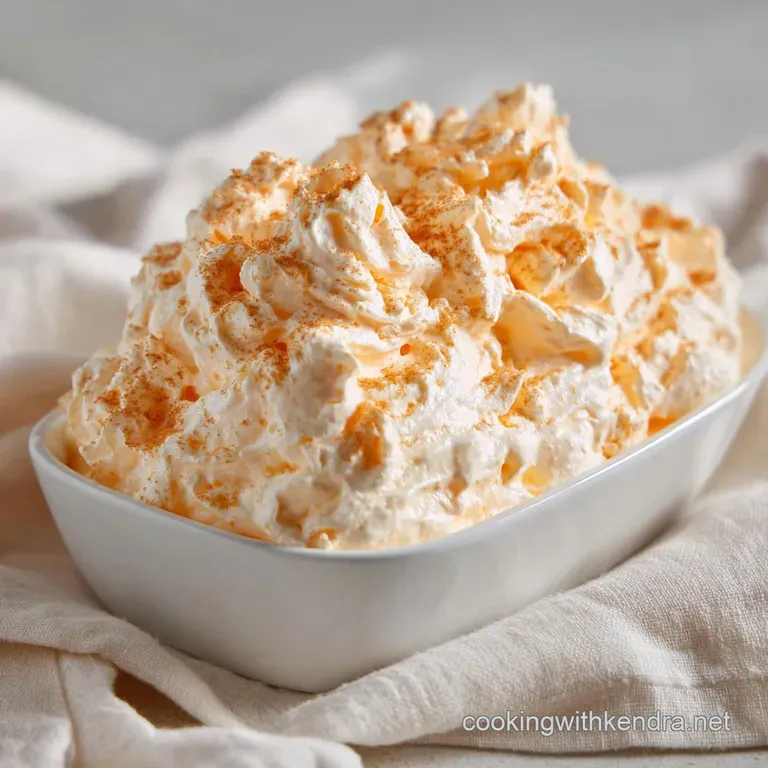
- Time: Active 15 minutes, Passive 120 minutes, Total 135 minutes
- Flavor/Texture Hook: Airy, citrus bright, and velvety smooth
- Perfect for: Summer cookouts, holiday potlucks, and busy weeknight treats
- Why Most Recipes Fail This Orange Fluff Salad
- Important Time and Yield Specifications
- Essential Elements for Your Orange Fluff Salad
- Necessary Tools for Success
- Master the Mixing Process
- Fixes for Common Fluff Problems
- Guidelines for Scaling and Growth
- Creative Twists and Flavor Swaps
- Myth Busting the Fluff Legend
- Strategic Storage and Zero Waste
- How to Serve and Enjoy
- Recipe FAQs
- 📝 Recipe Card
Why Most Recipes Fail This Orange Fluff Salad
I remember the first time I saw this bright, neon orange bowl sitting on my Aunt Martha’s picnic table. It was one of those humid July afternoons where the air feels like a warm blanket, and the smell of charcoal smoke is thick in the yard.
While the adults were fussing over the ribs, us kids were hovering over this bowl of shimmering, airy clouds. There is something about the way the cool, whipped texture hits your tongue right after a salty burger that just makes sense.
It’s pure nostalgia in a bowl, a relic from an era where "salad" was a very loose term, but it’s the dish that always comes home empty.
But here is the thing: I’ve been to enough church basements and family reunions to know that not all fluff is created equal. I have seen versions that are watery puddles by the time the prayer is over, and others that are so sweet they make your teeth ache.
The secret isn't some expensive ingredient or a hidden French technique; it is all about managing moisture and giving the ingredients time to actually get to know each other in the fridge.
We’re going to talk about why that cottage cheese needs to be small curd and why you absolutely cannot rush the "cure" time for those marshmallows.
Important Time and Yield Specifications
Before we get our hands messy, we need to talk about the roadmap. This isn't a dish you can whip up five minutes before the guests arrive. While the hands on work is almost non existent, the "cook" time (which is really just a long, cold nap in the fridge) is where the magic happens.
You’re looking at a solid two hours of waiting, but trust me, your patience will be rewarded with a texture that is stable enough to scoop but light enough to melt.
| Servings | Gelatin (3 oz) | Cottage Cheese (16 oz) | Whipped Topping (8 oz) | Set Time |
|---|---|---|---|---|
| 6 people | 0.5 package | 1 cup | 4 oz | 2 hours |
| 12 people | 1 package | 2 cups | 8 oz | 2 hours |
| 24 people | 2 packages | 4 cups | 16 oz | 3 hours |
If you are feeding a huge crowd at a graduation party or a massive Thanksgiving dinner, you can easily double this. Just remember that the more volume you have, the longer it takes for that gelatin to properly set. For a double batch, I usually let it sit for at least three hours just to be safe.
You want it to be firm enough that a spoon leaves a distinct path when you dig in.
Essential Elements for Your Orange Fluff Salad
We need to understand how these disparate textures chunky cottage cheese, airy whipped topping, and fibrous fruit come together to form a cohesive bite. It's almost like building a wall; you need the bricks and the mortar, but you also need to make sure the foundation isn't soggy.
The Hydration Factor: The dry gelatin powder actually leeches moisture from the cottage cheese, which hydrates the crystals without the need for boiling water. This creates a concentrated orange flavor that doesn't get diluted.
Marshmallow Osmosis: Over the course of two hours, the marshmallows absorb the surrounding liquid, transforming from chewy nuggets into soft, pillowy clouds that mimic the texture of the whipped cream.
Aeration Stability: By folding rather than stirring, we keep the air bubbles in the whipped topping intact. This is the difference between a "fluff" and a "glop."
Ingredient Deep Dive
| Ingredient | Science Role | Pro Secret |
|---|---|---|
| Orange Gelatin | Structural Binder | Use name brand for a more vibrant color and consistent set. |
| Cottage Cheese | Protein/Texture | Small curd is non negotiable for a velvety mouthfeel that isn't too lumpy. |
| Whipped Topping | Aeration | Ensure it is fully thawed in the fridge, never the microwave, to prevent weeping. |
| Mandarin Oranges | Acid/Burst | Drain them for 10 minutes; any leftover juice will break down the cream. |
For this Orange Fluff Salad, the texture is everything. Much like how a homemade Japanese mayo relies on the right fat to acid ratio to stay silky, this salad relies on the cottage cheese and gelatin to create a stable emulsion that won't separate as it sits on your serving table.
Components and Substitutes
- 1 package (3 oz) Orange Gelatin powder: This is the glue and the flavor.
- Substitute: sugar-free gelatin works perfectly if you’re watching calories, though the color is slightly less neon. Why this? The gelatin provides the structure that keeps the fluff from becoming a liquid mess.
- 1 container (16 oz) Small curd cottage cheese: This provides the body and a surprising hit of protein.
- Substitute: Ricotta cheese can work, but it will be much denser and less "tangy." Why this? Small curd blends into the whipped topping more seamlessly than large curd.
- 1 tub (8 oz) Whipped topping, thawed: This is your air.
- Substitute: Stabilized whipped cream (heavy cream whipped with gelatin) if you want to avoid oil based toppings. Why this? store-bought whipped topping stays stable longer at room temperature than real cream.
- 2 cans (11 oz each) Mandarin oranges: The citrus pop.
- Substitute: Fresh clementine segments, though you must remove all the white pith. Why this? Canned mandarins are soft enough to fold in without breaking.
- 1 can (20 oz) Crushed pineapple: The tropical backbone.
- Substitute: Tidbit pineapple if you want larger fruit chunks. Why this? Crushed pineapple distributes flavor into every single bite.
- 2 cups Miniature marshmallows: The texture magic.
- Substitute: Fruit flavored mini marshmallows for a "rainbow" look. Why this? They soften during the chill time to create the "fluff" sensation.
Necessary Tools for Success
You don't need a stand mixer or anything fancy for this. In fact, a stand mixer would probably overwork the mixture and deflate all that beautiful air. I always reach for my biggest glass bowl because I love seeing the layers as I fold, and it makes for a pretty presentation if you’re serving straight from the mixing bowl.
- Fine mesh strainer: Essential for getting every last drop of juice out of the pineapple.
- Large silicone spatula: You need something flexible to scrape the bottom of the bowl.
- Large mixing bowl: Glass or stainless steel is best to keep the ingredients cold.
- Plastic wrap: To seal in moisture during the two hour chill.
Chef's Tip: Before you start, put your mixing bowl in the fridge for 10 minutes. A cold bowl helps keep the whipped topping from melting while you’re working with it.
Master the Mixing Process
Eliminating Excess Liquid
The first step is the most boring but the most important. Place the mandarin oranges and crushed pineapple into a fine mesh strainer over the sink. Let them sit for at least 10 minutes. Don't just let gravity do the work; take a large spoon and gently press down on the pineapple.
You will be shocked at how much juice is still hiding in there. If you skip this, your salad will be "weepy" within an hour.
Combining the Foundation
In your large, chilled mixing bowl, dump in the dry orange gelatin powder and the entire container of cottage cheese. Stir these together with your spatula. At first, it’ll look like grainy orange cottage cheese, but keep going until the powder is fully dissolved.
You want a uniform, vibrant orange color with no streaks of white left. This ensures the flavor is evenly distributed.
Folding for Aeration
Now, add your thawed whipped topping. This is where you have to be gentle. Do not "stir." Use a 'cut and fold' motion: slice the spatula through the center, scrape along the bottom, and lift the mixture over the top. Rotate the bowl as you go. You want to maintain that aeration.
If you stir too fast, you’ll knock the air out and end up with a heavy orange soup.
Incorporating the Texture
Add the drained mandarin oranges, the bone dry crushed pineapple, and the 2 cups of mini marshmallows. Again, fold gently. You want the fruit to remain intact those mandarin segments are delicate! Stop the moment everything looks evenly speckled with fruit and marshmallows.
Over mixing at this stage is the enemy of a velvety finish.
Setting the Structure
Cover the bowl tightly with plastic wrap or a lid. This is non negotiable: it has to go into the fridge for at least 120 minutes (2 hours). During this time, the gelatin sets up the cream, and the marshmallows undergo their transformation.
They absorb the excess moisture and become soft, like little clouds. I’ve tried eating it after 30 minutes, and it’s just not the same; the marshmallows are still too chewy.
Fixes for Common Fluff Problems
Even a simple recipe can have a bad day. Usually, the issues come down to temperature or moisture control. If you find your salad looks a bit off, don't panic. Most things can be fixed if caught early enough.
Solving the Separation Issue
If you notice a layer of orange liquid at the bottom of the bowl after chilling, it means the fruit wasn't drained enough or the whipped topping was too warm when you folded it in. To fix this, you can gently fold in an extra half cup of marshmallows.
They will act like little sponges and soak up that extra liquid as the salad sits.
Fixing a Grainy Texture
Sometimes the gelatin powder doesn't dissolve completely, leaving you with a slightly sandy mouthfeel. This usually happens if the cottage cheese was straight out of a super cold fridge or if the mixture wasn't stirred enough in step two. If you catch this before adding the whipped topping, just keep stirring.
If it’s already mixed, let it sit at room temperature for 10 minutes to help the sugar dissolve, then give it one very gentle fold and put it back in the fridge.
| Problem | Root Cause | Solution |
|---|---|---|
| Too Runny | Excess fruit juice or melted topping | Fold in more marshmallows or a bit more whipped topping. |
| Too Thick | Not enough fruit or over chilled | Let sit at room temp for 10 mins; fold in a splash of orange juice. |
| Lumpy Cream | Large curd cottage cheese used | Pulse the cottage cheese in a blender before adding gelatin. |
Common Mistakes Checklist
- ✓ Squeeze the pineapple until it feels almost dry to the touch (prevents a watery mess).
- ✓ Ensure the whipped topping is completely thawed (prevents lumps and uneven mixing).
- ✓ Use small curd cottage cheese (large curd creates a strange, chunky texture).
- ✓ Give it the full 2 hours in the fridge (the marshmallows need time to "cure").
- ✓ Avoid using fresh pineapple (the enzymes in fresh pineapple prevent gelatin from setting).
Guidelines for Scaling and Growth
When you need to feed the whole neighborhood, scaling this recipe is pretty straightforward. However, there are a few "chef secrets" to doubling or tripling the batch without losing that signature lightness.
Scaling Down (Half Batch) If you're just making this for a quiet Tuesday night dinner, use a 1.5 oz portion of the gelatin (half a box) and half of all the other ingredients. Use a smaller bowl so the mixture doesn't spread out too thin, which can cause it to lose air.
The set time remains the same at 120 minutes.
Scaling Up (Double or Triple) When doubling, don't just dump everything in at once. I find it’s better to work in two separate bowls if you have them. If you must use one giant bowl, increase your folding time.
Also, be careful with the marshmallows; if you triple the recipe, use only 2.5x the marshmallows, otherwise, it becomes a "marshmallow salad" rather than a "fluff salad." The fruit can also be scaled 1:1, but ensure your strainer is big enough to handle the volume so the fruit at the bottom doesn't stay soggy.
Creative Twists and Flavor Swaps
Once you have the classic orange version down, you can start playing with the "Dreamsicle" vibe. My family loves it when I add a teaspoon of pure vanilla extract to the cottage cheese mixture; it really brings out that ice cream truck flavor. You can also play with the acidity.
If you find the recipe a bit too sweet, a tablespoon of lemon juice can brighten the whole thing up.
For a more savory adjacent citrus experience, you might think about how citrus interacts with fat in other recipes, like a Mojo de Ajo sauce. While that’s a garlic heavy sauce, the principle of using acid to cut through creaminess is exactly what makes the mandarin oranges so vital here.
| Original | Swap | Why It Works |
|---|---|---|
| Orange Gelatin | Lime Gelatin | Creates a "Pear Fluff" style; swap oranges for canned pears. |
| Mandarin Oranges | Maraschino Cherries | Adds a festive red color and a "cherry limeade" flavor profile. |
| Mini Marshmallows | Shredded Coconut | Adds a "shatter" texture and tropical notes. Note: Denser result. |
Myth Busting the Fluff Legend
Myth: You can't taste the cottage cheese.Truth: This is actually true! The gelatin and whipped topping completely mask the "cheesy" flavor. The cottage cheese is purely there for the structure and the creamy mouthfeel.
Most people who say they hate cottage cheese will devour two helpings of this without ever knowing it's in there.
Myth: You can use fresh pineapple for a "healthier" version.Truth: This is a dangerous game. Fresh pineapple contains an enzyme called bromelain which breaks down gelatin proteins. If you use fresh, your salad will never set it will remain a soup forever.
Canned pineapple is heat treated during the canning process, which destroys that enzyme, making it safe for fluff.
Myth: The marshmallows are just for show.Truth: As we discussed, they are functional sponges. They are the secret weapon against weeping. Without them, the salad wouldn't hold its shape for more than a few hours.
Strategic Storage and Zero Waste
This salad is a champion of the fridge, but it does have a shelf life. Because it's a dairy based emulsion, you want to keep it as cold as possible for as long as possible.
Storage Guidelines Keep the Orange Fluff Salad in an airtight container in the back of the fridge (where it's coldest). It will stay perfectly velvety for about 3 to 5 days.
After day three, you might notice a little bit of liquid pooling at the bottom just give it a very gentle fold to re incorporate. I do not recommend freezing this; the cottage cheese and whipped topping will separate when thawed, leaving you with a grainy, watery mess that no one wants to eat.
Zero Waste Tips Don't throw away that leftover pineapple and mandarin juice from the draining process! I always save it in a mason jar in the fridge. It’s a delicious "tropical punch" base for the kids, or you can use it to deglaze a pan for a sweet and sour chicken dinner later in the week.
If you have leftover marshmallows that are starting to get stale, they are perfect for this recipe because they'll soften up in the cream anyway.
How to Serve and Enjoy
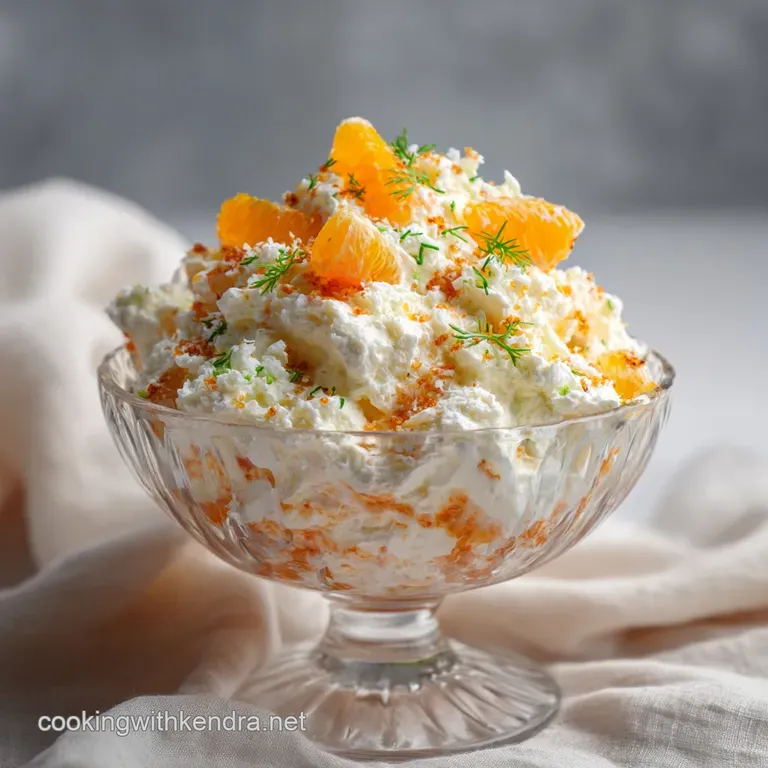
Presentation is where you can really make this old school dish feel modern. Instead of just plopping it into a plastic bowl, try serving it in individual glass coupes or martini glasses. Top each one with a single, perfectly intact mandarin segment and a tiny sprig of fresh mint.
The green against the orange is stunning.
It’s best served very cold, right out of the fridge. It pairs beautifully with salty, savory foods. If you’re doing a big Sunday roast, this acts as a refreshing palate cleanser. Or, if you’re at a summer BBQ, it’s the perfect companion to spicy pulled pork.
The creamy, cool texture cuts right through the heat and the fat, making every bite of your main course taste better. Just remember: once it’s on the table, it shouldn’t sit out for more than two hours. Keep it in a bowl of ice if the party is outdoors!
Recipe FAQs
What are the ingredients for orange fluff?
You need six specific items. This salad requires one package of orange gelatin powder, 16 ounces of small curd cottage cheese, an 8-ounce tub of thawed whipped topping, two 11-ounce cans of drained mandarin oranges, one 20-ounce can of well drained crushed pineapple, and two cups of miniature
marshmallows.
Is orange fluff salad a Midwestern thing?
Yes, it is a staple of Midwestern potlucks. This dessert salad, often referred to as "Orange Jello Salad," has deep roots in the region's culinary culture where creamy, gelatin based desserts are traditional favorites.
Can orange fluff be made ahead of time?
Yes, it is best made in advance. The recipe must refrigerate for at least 2 hours so the marshmallows can soften and the gelatin can properly set the structure.
What is the orange salad called?
It is most commonly known as Orange Fluff. Some people also refer to it as Mandarin Orange Salad or Orange Jello Salad depending on their family traditions.
How to keep the salad from becoming watery?
Squeeze the pineapple until it feels almost dry to the touch. Placing the pineapple and mandarin oranges in a fine mesh strainer and pressing them with a spoon to remove every drop of juice is essential to prevent separation.
Is it true I can substitute fresh pineapple for the canned version?
No, this is a common misconception. You must use canned crushed pineapple because the enzymes in fresh pineapple will prevent the gelatin from setting, resulting in a liquid mess.
How to achieve the perfect airy texture?
Fold the whipped topping using a silicone spatula with a 'cut and fold' motion. If you enjoyed maintaining the delicate texture here, the same principle of gentle ingredient folding applies to keeping your dishes light and aerated.
Classic Orange Fluff Salad
Ingredients:
Instructions:
Nutrition Facts:
| Calories | 164 kcal |
|---|---|
| Protein | 4.9 g |
| Fat | 5.3 g |
| Carbs | 24.5 g |
| Fiber | 0.4 g |
| Sugar | 20.8 g |
| Sodium | 173 mg |
